Thursday, January 29, 2009

Stone Forest, Kunming

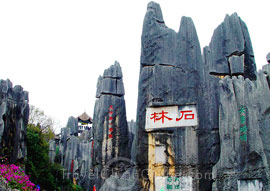
Jan. 21: We visited the Stone Forest, a massive collection of limestone pillars eroded by wind and rain to shape fanciful forms.

Kunming, the capital of Yunnan Province, enjoys great fame among tourists not only because the region features a consistently warm climate, but also thanks to its wonderful vistas and landscapes. Among the most dramatic of these attractions is the Stone Forest (Shilin), known since the Ming Dynasty (1368-1644 A.D.) as the 'First Wonder of the World.'

The Stone Forest is in Lunan Yi Nationality Autonomous County, which is about 120 kilometers (75 miles) from Kunming and requires only a three-hour drive. It covers an area of 400 square kilometers (96,000 acres) and includes both large and small stone forests, as well as many other scenic spots. An old local saying says that 'If you have visited Kunming without seeing the Stone Forest, you have wasted your time.' Truly, the Stone Forest is one of the most important attractions of Yunnan. For more information, see http://www.travelchinaguide.com/attraction/yunnan/kunming/stone_forest.htm.


Happy Niu Year!

We came home from Kunming just in time to celebrate the Chinese Niu (Ox) Year! We arrived in Jinan at 6 PM and we heard rumbling all over town with fireworks and firecrackers. The rumbling caused car alarms to set off everywhere. It was quite a sight.

Young men had a great time setting off fireworks, especially the ones we watched at the Soccer Stadium. We also noticed some women burning papers by the roadside. Out of respect for them, we didn't take the pictures as it looked like religious ritual.

We thought all the stores would be closed on New Year's day, but found RT-Mart open. We shopped for some grocery and had dinner at McDonald. So much for spending this special day in China. Of course, we've had Chinese food twice everyday during our Southwestern Tour that we were all happy to have a big Mac.

On the second day of the New Year, we went to visit "Thousand Buddha Mountain". Street vendors lined both sides to the entrance selling Buddhist's wares. It was very crowded as people burned incense outside of the many temples. It filled the air with smoke.

"The Thousand Buddha" was covered with gold leaf and measured about 50 feet tall and 60 feet high. According to "chinatravelguide.com", the Thousand Buddha Mountain is as follows:

Lying 2.5 kilometers (1.55 miles) to the south of Jinan, Shandong Province, the Thousand-Buddha Mountain is one of the key points of interest in the city of Jinan. It is about 258 meters high (846 feet) ranging from east to west. It has been constructed into a park in1959 which occupies an area of about 166 hectare (140 acres).


Wednesday, January 28, 2009

Shanghai, China

The Pearl Tower at the Bund (Wai Tan) in Shanghai
January 9, 10 & 11, 2009

Welcome to Shanghai

With a history of more than 700 years, Shanghai was once the financial center of the Far East. Since the reforms that began in the 1990s, great changes have taken place in the city. The municipal government is working towards building Shanghai into a modern metropolis and into a world economic, financial, trading and shipping center by 2020.

My sister Alice flew in to Pudong, Shanghai Airport at 6 PM, on Jan. 9. We left Suzhou in the afternoon to pick her up. It was a good reunion as the three of us haven't see each other since July of last year. We stayed at the Ramada Inn in Hongqiao. It was a nice clean hotel and cost 250 RMB (38 USD) per room. We got 3 rooms, one for Ling and Alice, one for the driver and the other on for Elwin and me. It was like staying at a Fairfield Inn, no extras, but functional.

Xiao Jiang, the driver, knew Shanghai well. So he planned the tours for us. First, he took us to Hongqiao to a DVD, CD store. We bought some DVDs, nothing special, but, Ling bought the Star Trek, Voyager series, with over 60 DVDs. Wow, that was something. We ate at a restuarant that served Taiwanese food. We heard there were over 30,000 Taiwanese people there. They put in a lot of investiment in Shanghai.

The next day, we went to the Shanghai Science and Technology museum. It was a humongous building with 4 I-MAX theaters. We spent over 4 hours there and had a great time. When we came out, we were greeted with salespeople who coerced us to shop at their stores. We had a good time shopping, that included Elwin too. It was amazing.

We then went to the Bund at the Huang Pu River. Many German buildings remained. We walked along the shore to enjoy the beautiful night light. Ling, Elwin and I, braved the frigid weather and walked to the famed Nanjing Dong Lu to see merchants everywhere. We dared not touch anything as the salespeople swamped around us to purchase stuff. It was very interesting.

Shanghai is a great city with all the beautiful architechtural buildings. They are in so many different shapes. It was great. We didn't find too many bargains, but who could with such a short time? We plan to come back.

On Sunday, we were able to attend the Shanghai 1st branch. We didn't see any of the BYU China teachers because they were all on spring holiday break, but did meet many friendly members of the church there. How wonderful to find fellow saints in China! After the 3-hour block, we left to pick up Alice, had lunch, and then headed for Ling's house in Dagang. We arrived in Dagang at around 5 PM and was greeted by Xiao Ping with dishes of her delicious, fabulous cooking. It was wonderful.

Tuesday, January 27, 2009

Suzhou, China

January 8 & 9, 2009

We have anticipated our visit to Suzhou for a long time. Elwin used to come to work in Suzhou before retiring from Philips Consumer Electronics. We also found our old friends, the Ai family, back in Suzhou with Ruijun Ai working for Philips as a manager. Ruijun and Susan got married when he was working in El Paso for Philips. Susan and I used to run around together as she was learning to adjust to her new life in America. We became best of friends. In 2002, the Ai's moved to the Netherlands to work at the Headquarter of Philips, and we lost contact with each other.

You can imagine the surprise when we got a phone call from Ruijun one day in December. Through a mutual friend, Gary McMahon, both Rui and Elwin's former boss, we were reunited. We talked on the phone and decided that we would go down to visit during the Spring Festival. It was a happy reunion to find the Ai's with 2 boys, ages 7 and 4. Bryan was born in El Paso and we were surrogate grandparents. He is now a 2nd grader and learning to speak English already.

Ling and her driver took us down to Suzhou from Dagang, and the Ai's arranged for us to stay at a beautiful hotel by the amusement park. We had lunch at a Xinjiang restaurant since Reijun and Susan grew up in Xinjiang and talked about their growing up years there many times. The food was excellent, and for the first time in my life, I had lamb; it was good. We then went to a silk factory for a tour. Suzhou is famous for their silk and is the silk capital of the China. Susan also took us to a silk embroidery wholesale market about 30 minutes outside of Suzhou. It was so fun to see ladies embroidering on a big hoop. Susan purchased a silk embroidered painting with 5 birds in a garden for our daughter Elaine since they met in El Paso and became fast friends.

On the second day, Susan took us to the famous Suzhou Garden. There is a replica of the garden in Portland, Oregon, as the two cities are sister cities. The garden in Suzhou was built by a rich merchant at the end of the Ming Dynasty. He was so paranoid of people murdering him that he built himself a big 2-story office, carved out of the side of the mountain with no apparent entrance. The only way to get in was to go through a cave. He built a palace house for each of his concubines and a beautiful study for his children, with windows on all four sides, so they could enjoy the nature. On one side, the windows had different colors of blocks to simulate seasons. Outside of the study was a pond with gold fish. It's called the rain drop pond as his children listened to the rain falling into the pond.

Other interesting buildings are the pavilions. One of them had 4 sides with each showing 4 different seasons: plum blossoms for spring, lotus blossoms in the pond for the summer, a bamboo grove for the fall and snow for the winter. It's hard to imagine that people 500 years ago enjoyed such elaborate living quarters.

While we were busy visiting places, Elwin was at Philips building working with Ruijun. Two things kept him very busy there. Philips has revived the "remote locator" that Elwin and a co-worker designed and produced 30 years ago. He had a lot to share on that. Another interesting thing was that when the people there found out Elwin was teaching English at Shandong University, they asked him to teach the engineers English. He was kept busy and also asked to come back to Suzhou to be their teachers. It's been very interesting.

We ended up with dinner at a beautiful vegetarian buffet restaurant. It was amazing to see all sorts of foods that were vegetables, vegi chicken drum sticks, and vegi steaks were a few of them. They also provided a hotpot with clear broth and various mushrooms, and other vegis, of course. Everyone ended the dinner with ice-cream sundaes.

It was a fun visit with the Ai's. We'll be back!

Monday, January 26, 2009

Yangshuo, China

Fisherman w/ cormorants

Jan.19: (Monday) (Breakfast+Lunch+Dinner) GUILIN TO YANGSHUO BOAT

A 41/2 hour cruise down the Li River, the connecting waterway between Guilin and Yangshuo, is on the agenda for this morning. A thousand years ago a poet wrote of the scenery in this area:“The river forms s green gauze belt, the mountains are like blue jade hairpins.” Perhaps it is not exactly that but you will see some extraordinary limestone peaks, sprays of bamboo along the riverbanks, cormorant fisherman in small boats, and picturesque villages. Upon arrival in Yangshuo take time to scout the street markets and the “western street” markets. In the evening, enjoy the cormorants catching fishes performance on small boats.

By far, this was the most beautiful stretch of China. About 15 minutes into Li River, we started seeing the mountains coming up all around the shores. It was the most incredible sight. Most of us stood on the deck to take in the scenery. The attendants had to call for us for several minutes to come in to have lunch. Lunch was fine, but dealing with salesmen on the rafts selling their wares was more interesting. A couple of them hooked their rafts to the side of the cruise ship and handed to the people on the deck all sorts of stones (I got a small amethyst crystal for USD 3), jade statues, hats, scarves to negotiate an agreeable price. It was really fun.

We arrived in Yangshuo at around 2 PM. As we stepped off the boat, we were surrounded by the street vendors. The street market was about 1/2 mile long and completely covered with merchandise on both sides. Several of us had to go to the post office to ship some gifts home because we ran out of room at this first part of the Southwestern China tour. :-)

After a delicious dinner, we, about 50 BYU China teachers, Ling and Alice, headed for a night ride on small boats. A fisherman stood on the raft with a long pole in his hand pushing the raft along with several cormorants.


According to Gil Azouri:

Using cormorant to fish is an ancient practice in Japan and China. In Japan, cormorant fishermen puts a tethered steel ring around the bird’s neck (to prevent them from swallowing the fish). One fisherman usually handles ten to twelve birds at a time.

In China, the cormorants are more like beloved pets to the fisherman - he would train the bird to catch the fish and release it to him instead of swallowing it.

The fisherman we saw during the boat trip had put a string around the neck of each cormorant. The cormorants dove into the water whenever they saw fish. They picked up the fish, but could not swallow because of the string around their neck. After a few catches, the fisherman pushed them in, grabbed them with his hands, and turned them upside down. We saw 4 or more fish come of their mouth. It was very amazing. After we reached the shore, the fisherman let us hold the cormorant by putting it on our arm. You'll see some pictures below. It was an incredible experience.

The hotel was very nice. As usual, we had breakfast buffet at the hotel. They provided both Chinese and Western breakfasts for us to choose from. We were again in hog heaven. :-) Manana...we'll start dieting. :-)

Below is a slideshow of the cruise down Li River, the beautiful mountains and cormorants catching fishes.

Guilin, China

Jan.18(Sunday) (Dinner) HONGKONG TO SHENZHEN TO GUILIN BUS+FLIGHT

Depart Hong Kong for Shenzhen by chartered bus at 2:30Pm in front of YMCA hotel. The bus will have the BYU sign outside of the front windshield. Marvin or tour guide will meet the group outside the customs area at the Shenzhen. Transfer to Shenzhen airport and take the evening flight to Guilin.

Jan. 19: Took a 4 1/2 -hour cruise down the Li River from Guilin to Yangshuo. We did some shopping at Yangshuo. Then, we took a golf cart ride to visit the countryside. We traveled down the backroads and fields to see lush farmland, rice paddies, and some of the most beautiful scenery you can magine. We spent the night at the Yanghuo Regent Holiday Hotel.

Jan. 20: We traveled by bus back to Guilin. Visited the Reed Flute Cave, then boarded a flight to Kunming. We stayed at the Kunming Greenland Hotel.

Guilin Introduction: The

Finest Under Heaven
Situated in the northeast corner of the Guangxi Zhuang Autonomous Region, Guilin is hailed by many as the most beautiful place in China and is one of the must-see destinations for most foreign tourists. According to a popular Chinese saying, “Guilin’s scenery bests all others in the world.” Its shapely-rising limestone towers and crystal-clear waters are often portrayed in Chinese artworks. Adding to its natural beauty are many fascinating caves.

The city of Guilin was founded in the Qin Dynasty in 314 BC as a small settlement on the Lijiang River. It became increasingly important following the construction of a canal joining the river with another further north, providing a transport link with the Yangzi. The imperial court could thus send food and provisions by water from the Yangzi plains to its armies in the far south. The town becamguiling the provincial capital in the Ming Dynasty, and remained so until 1914, when the capital was moved to Nanning.

Since the founding of the People's Republic in 1949, Guilin has developed a fledging industry, producing a variety of products such as pharmaceutical goods, tires, machinery, fertilizers and silk. From its noted profusion of flowering cassia trees, which have a strong sweet scent, it produces a number of specialties including perfume, wine, tea, cinnamon, and herbal medicine.


Beautiful Li River, Guilin


Friday, January 23, 2009

Southwest Tour in China

Ling @ the Stone Mountain
Stone Mountain in Lijiang

Elwin & Shirley at Stone Mountain

Alice @Stone Mountain

Stone Mountain
Ling, Elwin, Shirley & Alice @ Stone Mountain

Guilin Mountains - beautiful, breathtaking

salesman making a living

Guilin Mountains - unbelievably beautiful


Elwin, Shirley, Alice & Ling at the Bund in Shanghai


The Bai Minority Group in Yunan - doing a wedding dance

Elwin & Shirley at Kunming Lake


Ling, Shirley & Alice at the Park

At Erhai Lake

Winter Holiday Tour in Southwestern China (8 days) - this has been a most wonderful trip. We are enjoying every bit of it. Just thought I'd post the itinerary to share with you what we've been doing. BTW, with all the breakfast+lunch+dinner, we all have gained at least 8 pounds each. You can guess what our New Year's resolution is going to be this year.


Jan.18(Sunday) (Dinner) HONGKONG TO SHENZHEN TO GUILIN BUS+FLIGHT

Depart Hong Kong for Shenzhen by chartered bus at 2:30Pm in front of YMCA hotel. The bus will have the BYU sign outside of the front windshield. Marvin or tour guide will meet the group outside the customs area at the Shenzhen. Transfer to Shenzhen airport and take the evening flight to Guilin.

Overnight in Guilin(4 star hotel)


Jan.19: (Monday) (Breakfast+Lunch+Dinner) GUILIN TO YANGSHUO BOAT

A 41/2 hour cruise down the Li River, the connecting waterway between Guilin and Yangshuo, is on the agenda foe this morning. A thousand years ago a poet wrote of the scenery in this area:“The river forms s green gauze belt, the mountains are like blue jade hairpins.” Perhaps it is not exactly that but you will see some extraordinary limestone peaks, sprays of bamboo along the riverbanks, cormorant fisherman in small boats, and picturesque villages. Upon arrival in Yangshuo take time to scout the street markets and the “western street” markets. In the evening, enjoy the cormorants catching fishes performance on small boats.

Overnight in Yangshuo, 4 star hotel


Jan.20: (Tuesday)(Breakfast+Lunch+Dinner) GUILIN TO KUNMING FLIGHT

Spend a leisurely morning visiting the countryside by cart. Travel down the backroads and fields to see lush farmland, rice paddies, and some of the most beautiful scenery you can imagine. After lunch, travel by bus back to Guilin. Visit Reed Flute Cave,240 meters underground and filled with exotic rock formations and fantastic shapes lit by colored lights. The Crystal palace of the Dragon King, a grotto in the center of the cave, can hold more than a 1000 people. And the trunk hill park. That evening depart by air for Kunming.

Overnight in Kunming, 4 star hotel


Jan.21: (Wednesday) (Breakfast+Lunch+Dinner) KUNMING TO LIJIANG FLIGHT

Today you will visit the Stone Forest, a massive collection of limestone pillars eroded by wind and rain to shape fanciful forms. Board an afternoon or evening flight to historic Lijiang, near the Tibetan border in northern Yunnan Province.

Overnight in Lijiang ,4 star hotel


Jan.22: (Thursday) (Breakfast) LIJIANG

Take the entire day to explore Lijiang`s Old Town ---a delightful maze of cobbled streets, rickety old wooden buildings, gushing canals, bustling street markets tended by merchants in traditional Naxi costumes. Come and go as you please during the day! (Free time the whole day, meals on your own in the old town—you may try the local food, or western fast food).

Overnight in Lijiang, 4 star hotel


Jan.23: (Friday) (Breakfast+Lunch+Dinner) LIJIANG TO DALI BUS

Visit the Shuhe ancient town near Lijiang which is more natural and older and also a visit a local village of Naxi Minority. Take a leisurely stroll around Black Dragon Pool Park. Be sure and have the camera ready to use! There are some fantastic photo opportunities here. Travel to Dali by bus this afternoon. This historic city is set against a stunning backdrop. Take a boat trip on Erhai Lake with the imposing Cangshan mountain range behind it. After check in at the hotel, you will have free time to explore the old section of Dali that evening.

Overnight in Dali, 5 star (excellent)


Jan 24: (Saturday) (Breakfast+Lunch+Dinner) DALI TO KUNMING FLIGHT

Enjoy a Bai(ethnic group) song and dance performance.

Take afternoon flight to Kunming and upon arriving there, visit the Grand Pavilion in Kunming to appreciate the ancient culture and literature of China.

Overnight in Kunming, 4 star hotel


Jan 25: (Sunday) (Breakfast) KUNMING TO HOME CITIES OR HANOI FLIGHT

Depart Kunming by air for home cities. (Fly to Hanoi for those who are taking the Vietnam and Cambodia trip)